


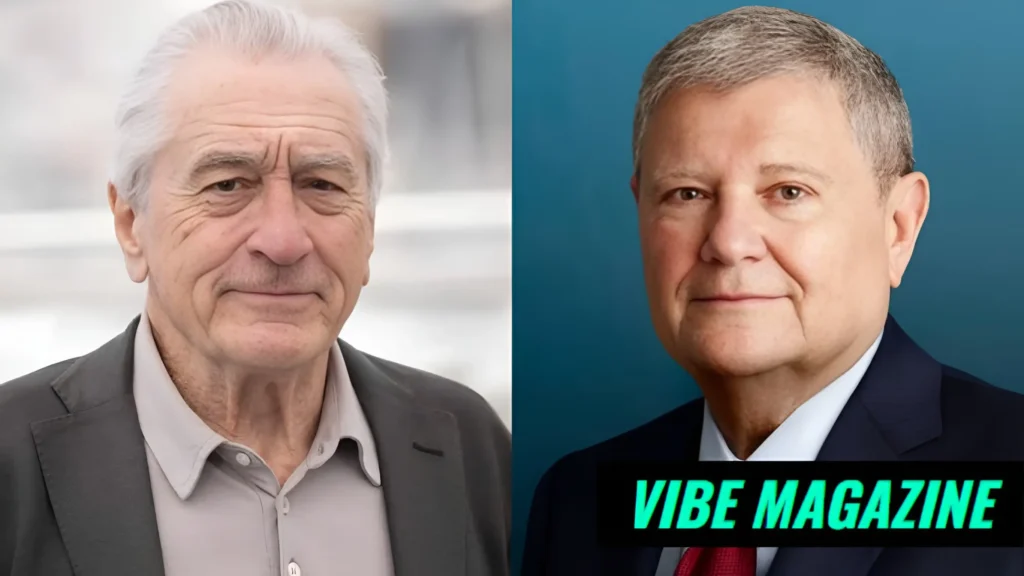
New York has always been a city where very different kinds of ambition occupy the same few miles. A developer can spend decades thinking about towers, offices, neighborhoods, and the financial structures that make large projects possible, while an actor can spend an equally long career turning streets, rooms, and people into stories that travel around the world. The city absorbs both kinds of work, often without making a clear distinction between the people who physically shape it and those who help define its cultural image.
That makes Jerry Speyer and Robert De Niro an unusual but interesting pair of names to consider together. Speyer belongs primarily to the world of real estate, investment, and corporate leadership. De Niro belongs to film, acting, producing, and the cultural industries. Their professional paths are not the same, and there is no established personal partnership between them that should be invented simply because their names appear in the same search.
The more legitimate connection is New York itself. Speyer has spent much of his professional life involved in the development, ownership, and management of major commercial properties associated with the city. De Niro was born and raised in Manhattan and built an acting career that repeatedly returned to New York as both a setting and a source of identity. His business interests have also extended into restaurants, hotels, film production, and the Tribeca neighborhood.
Seen from that perspective, their stories offer two different explanations of how prominent people can influence a city. One works largely through buildings, capital, organizations, and long-term development. The other has worked through films, restaurants, hospitality, storytelling, and cultural entrepreneurship. Neither career needs the other to be significant, yet both help illustrate the extraordinary range of professional worlds that coexist in New York.
| Fact | Jerry Speyer | Robert De Niro |
|---|---|---|
| Full Name | Jerry I. Speyer | Robert Anthony De Niro Jr. |
| Date of Birth | June 23, 1940 | August 17, 1943 |
| Place of Birth | Milwaukee, Wisconsin, United States | New York City, New York, United States |
| Nationality | American | American |
| Profession | Real-estate developer, business executive, investor | Actor, producer, director, entrepreneur |
| Famous Role / Known For | Co-founder and chairman of Tishman Speyer; major New York real-estate development | Taxi Driver, The Godfather Part II, Raging Bull, Goodfellas, Casino, The Irishman |
| Years Active | 1960s–present | 1960s–present |
| Net Worth | Estimated in the multibillion-dollar range; published estimates vary | Commonly estimated at around $500 million |
| Marital Status | Married | In a long-term relationship; previously married |
| Spouse | Katherine G. Farley | Previously married to Diahnne Abbott and Grace Hightower |
| Children | Four | Seven |
| Notable Works / Achievements | Co-founded Tishman Speyer; associated with major properties including Rockefeller Center and the MetLife Building; extensive civic and philanthropic leadership | Two Academy Awards; major collaborations with Martin Scorsese; co-founded Tribeca Productions; co-founded the Tribeca Festival; co-founded Nobu |
Two New York Stories Built in Different Worlds
A useful way to understand Jerry Speyer is to think about the physical city rather than celebrity culture. His career has been concerned with properties that have economic, architectural, and commercial lives extending far beyond any individual transaction. A successful real-estate project can influence where companies locate, how neighborhoods function, what kinds of businesses move into an area, and how people experience a particular part of the city.
Robert De Niro’s influence operates differently. His work is intangible in the traditional economic sense, but movies can give neighborhoods personalities that survive long after filming has ended. A New York street can become associated with a character, a restaurant can become part of a cultural story, and a local neighborhood can acquire an international identity through the people who work and create there.
De Niro’s relationship with New York is especially interesting because it is not simply the relationship of a celebrity who happens to live in the city. Manhattan was part of his upbringing. His parents were artists, and he grew up surrounded by the creative environment of Greenwich Village and Lower Manhattan.
Speyer’s connection is more institutional. His education, professional relationships, real-estate activities, civic responsibilities, and philanthropic positions have repeatedly placed him within the network of organizations that help manage and influence New York’s economic and cultural life.
Put together, these careers reveal something fundamental about the city: New York’s identity is created simultaneously by people building businesses and people creating culture.
Jerry Speyer’s Early Background
Jerry I. Speyer was born in Milwaukee in 1940, but his family moved to New York when he was very young. He grew up on Riverside Drive in Manhattan and attended Horace Mann School before entering Columbia University.
His academic background was not a straightforward preparation for a real-estate career. Speyer studied German literature at Columbia College and later earned an MBA from Columbia Business School. That combination is interesting because it reflects a broader characteristic of his career: business became his profession, but his interests and institutional affiliations extended well beyond commercial transactions.
Columbia remained important throughout his professional life. His later involvement with the university included senior leadership and board responsibilities, reflecting the kind of institutional role that eventually became a significant part of his public profile.
Speyer’s entry into the working world also came through New York. Before becoming one of the city’s best-known real-estate executives, he worked in the orbit of Madison Square Garden and later became involved with the Tishman real-estate organization.
The environment in which he developed his career was one in which property was closely connected to family business, finance, construction, corporate relationships, and the changing economics of Manhattan.
From Tishman to Tishman Speyer
The formation of Tishman Speyer in 1978 was the defining professional development of Speyer’s career. He established the company with his father-in-law, Robert Tishman, bringing together the Tishman family’s real-estate history with Speyer’s own business leadership.
Over the decades, Tishman Speyer became involved with major commercial properties in New York and other global markets.
Speyer’s career was therefore not based on one building or one acquisition. It developed through the accumulation of large projects, investment decisions, partnerships, property management, and institutional relationships.
One of the most recognizable names associated with the company is Rockefeller Center. The complex occupies a unique place in New York’s history because it is simultaneously an architectural landmark, a commercial destination, a tourism site, and a working business district.
Speyer’s association with Rockefeller Center demonstrates why real estate at this scale is different from ordinary property ownership. The decisions surrounding a landmark complex affect tenants, retailers, visitors, preservation concerns, public spaces, transportation patterns, and the city’s broader commercial image.
His professional portfolio has also included other major Manhattan properties, including the MetLife Building and the Chrysler Building at different points in the company’s history.
The significance of these assets is not simply their financial value. Large buildings become part of the daily infrastructure of a city. Most New Yorkers may never meet the executives responsible for them, but they encounter the consequences of decisions made about them every day.
Jerry Speyer and the Business of New York Real Estate
Real estate development is sometimes portrayed as a simple matter of buying property, constructing buildings, and collecting rent. At the institutional level, it is far more complicated.
Large developments require financing, legal structures, zoning considerations, architectural planning, tenant negotiations, construction management, market analysis, political awareness, and long-term asset management.
Speyer’s career developed around precisely this complicated environment.
His professional influence also extended into organizations connected with New York’s broader business community. He has held leadership roles involving the Real Estate Board of New York, the Partnership for New York City, and the Federal Reserve Bank of New York, among other institutions.
That breadth is important when considering a Jerry Speyer biography. His story is not only about buildings. It is also about the relationship between real estate, finance, education, civic organizations, medicine, culture, and philanthropy.
The larger a developer’s portfolio becomes, the more closely that career intersects with the institutions surrounding the city.
The Stuyvesant Town Chapter
Few examples better illustrate the scale and complexity of New York real estate than Stuyvesant Town and Peter Cooper Village.
The enormous residential complex has historically housed thousands of New Yorkers and occupies a large area of Manhattan’s East Side. Its ownership and financial history have been closely watched because decisions involving the property affect not only investors but also residents and the surrounding community.
Tishman Speyer and partner BlackRock acquired the property in 2006 in one of the most significant New York real-estate transactions of its era.
The investment later encountered severe financial difficulties, illustrating a reality that is sometimes forgotten when discussing major developers: enormous deals can carry enormous risks.
Real estate is a long-term business, but markets can change quickly. Debt structures, property values, rent regulations, interest rates, economic cycles, and tenant conditions can transform the outlook for an investment.
The Stuyvesant Town experience therefore became part of the larger story of how sophisticated real-estate investment interacts with the realities of urban life.
Speyer’s Civic and Philanthropic Influence
Jerry Speyer’s public role extends beyond property.
His involvement with institutions such as the Museum of Modern Art, New York-Presbyterian, Columbia University, and the National September 11 Memorial & Museum reflects another side of his career.
This institutional participation is particularly relevant when discussing New York business leaders because the city’s major executives often operate across several worlds at once. A person may be involved in property during the day and simultaneously serve on the board of a university, museum, hospital, or civic organization.
Speyer’s long association with cultural institutions also complicates the idea that real-estate leadership and cultural life are separate categories.
The same city that needs offices, apartments, hotels, and commercial centers also needs museums, universities, hospitals, foundations, and public institutions.
Speyer’s career has moved between those worlds.
Robert De Niro’s New York Childhood
Robert De Niro’s relationship with New York began long before international movie fame.
Born in Manhattan in 1943, De Niro was raised primarily by his mother, Virginia Admiral, after his parents separated when he was young. His father, Robert De Niro Sr., was a respected painter, sculptor, and poet.
Growing up around artists gave De Niro an early exposure to a creative community. The environment was very different from the commercial world that would later define much of Jerry Speyer’s career.
De Niro eventually left traditional high-school education and focused on acting. He studied with teachers including Stella Adler and Lee Strasberg, developing the serious approach to character work that became associated with his career.
His early years were not marked by immediate Hollywood success. He worked through smaller film roles and gradually established himself as a serious young actor.
The turning point came during the early 1970s.
The Actor Who Changed His Career
The year 1973 was particularly important because De Niro appeared in Bang the Drum Slowly and Mean Streets.
Mean Streets began his long creative relationship with Martin Scorsese, one of the most important collaborations in modern American cinema. Their partnership would eventually produce films including Taxi Driver, Raging Bull, Goodfellas, Casino, The King of Comedy, Cape Fear, and The Irishman.
De Niro’s performance style became closely associated with psychological intensity and deep character preparation.
His portrayal of Travis Bickle in Taxi Driver became one of the defining performances of American cinema. A few years later, his transformation into boxer Jake LaMotta in Raging Bull demonstrated an extraordinary willingness to physically and psychologically reshape himself for a role.
Then came The Godfather Part II, where De Niro played the young Vito Corleone.
That performance earned him his first Academy Award.
His second came for Raging Bull, where he won Best Actor.
The awards are important, but the larger story is the evolution of his career. De Niro was not content to remain associated with one kind of character. Over time, he moved between crime dramas, comedies, thrillers, family films, historical dramas, and more experimental projects.
De Niro and the New York Film Identity
Robert De Niro’s importance to New York culture is partly connected to the way the city appears throughout his filmography.
He became closely associated with filmmakers who treated New York as more than a background.
In films such as Mean Streets, Taxi Driver, and New York, New York, the city contributes to the atmosphere and identity of the story. Neighborhoods, streets, diners, apartments, clubs, and transportation systems become part of the narrative.
That makes De Niro’s relationship with New York different from the relationship of a celebrity who simply owns property there.
The city helped shape the characters he played, while his films helped shape the way audiences around the world imagined New York.
This is one reason the phrase Robert De Niro New York carries cultural meaning beyond geography.
Beyond Acting: De Niro as an Entrepreneur
De Niro’s career eventually expanded well beyond acting.
He became a producer and director, while also entering the hospitality industry.
His involvement with Tribeca became particularly important.
Tribeca Productions helped establish a platform for film production, while the Tribeca Film Festival, founded in the aftermath of the September 11 attacks, developed into an important cultural event associated with Lower Manhattan.
The festival’s creation also reflected De Niro’s broader relationship with the city. Instead of simply leaving New York for Hollywood, he became part of an effort to reinforce Lower Manhattan’s cultural identity.
His hospitality interests developed along a similar path.
De Niro became involved with Nobu alongside chef Nobu Matsuhisa and businessman Meir Teper. What began as a restaurant concept developed into a global hospitality brand encompassing restaurants and hotels.
He has also been associated with Tribeca Grill and The Greenwich Hotel.
These ventures show why describing De Niro only as an actor misses a major part of his professional development.
His business interests connect food, hotels, tourism, entertainment, luxury, and neighborhood identity.
The Importance of Tribeca
Tribeca is perhaps the most useful location for understanding De Niro’s broader New York identity.
The neighborhood has undergone major changes over the decades. Once associated strongly with industrial buildings and warehouses, it developed into a residential, cultural, and hospitality destination.
De Niro’s businesses and cultural activities became part of that transformation.
His involvement did not single-handedly create modern Tribeca, and it would be inaccurate to suggest otherwise. Neighborhood change results from thousands of residents, property owners, businesses, artists, investors, city policies, and broader economic trends.
But De Niro became one of the recognizable public figures associated with the area’s cultural identity.
His career therefore demonstrates a different type of urban influence from Speyer’s.
Speyer’s professional world deals directly with the physical and financial infrastructure of real estate. De Niro’s influence is more closely connected to the cultural and hospitality ecosystem that develops around places.
When Entertainment Becomes a Business
Celebrity entrepreneurship can sometimes look like a side activity attached to fame.
De Niro’s career illustrates a more complicated model.
A successful actor possesses several assets that can be translated into business: name recognition, relationships, cultural credibility, access to creative talent, and an understanding of what audiences respond to.
But celebrity alone does not guarantee that a restaurant or hotel will succeed.
Hospitality requires operations, financing, management, staff, branding, real-estate decisions, customer service, and consistency.
The growth of Nobu therefore represents more than a celebrity attaching his name to a restaurant.
It is an example of an entertainment figure becoming involved with a substantial operating business.
That makes De Niro relevant to conversations about celebrity entrepreneurship, particularly where hospitality and culture overlap.
Two Forms of Professional Risk
Jerry Speyer and Robert De Niro also illustrate very different definitions of professional risk.
For Speyer, risk can involve hundreds of millions or billions of dollars tied to property acquisitions, financing structures, development decisions, market cycles, and changing economic conditions.
A building cannot simply be rewritten if a decision proves unsuccessful. Real estate is physical and capital-intensive.
For De Niro, risk has a different character.
An actor can choose a role that fails commercially or critically. A director can make a film that audiences reject. A producer can invest in a project that never reaches expectations.
Creative risk is less easily measured in advance.
A film may appear commercially uncertain and later become a classic. A major investment in a property can appear attractive and become difficult when market conditions change.
Both careers therefore involve uncertainty, but the nature of the uncertainty is fundamentally different.
Visibility Is Another Major Difference
The public sees actors differently from business executives.
Robert De Niro has spent decades appearing in films, interviews, award ceremonies, photographs, and public events. His face is part of his professional product.
Jerry Speyer’s work is much less visible to ordinary people.
Most New Yorkers may recognize Rockefeller Center, the MetLife Building, or other major properties without knowing which executives were responsible for the investment decisions behind them.
That difference illustrates an important feature of modern cities.
Some people become famous because millions of people watch them perform. Others influence the city while remaining comparatively unknown to the general public.
Speyer’s career is therefore an example of institutional influence, while De Niro’s is an example of cultural visibility.
Neither requires the other to matter.
New York Real Estate Meets New York Culture
This is where the two careers become most interesting to compare.
A city needs physical infrastructure to function.
It needs offices, homes, hotels, transportation connections, retail spaces, restaurants, hospitals, schools, and cultural venues.
But a city also needs stories.
People do not experience New York only as a collection of buildings. They experience it through films, music, restaurants, neighborhoods, memories, art, and the personalities associated with particular places.
Speyer represents the infrastructure side of this equation.
De Niro represents part of the cultural side.
Yet the two categories constantly overlap.
A restaurant needs a building. A film festival needs venues. A hotel needs a location. A cultural district depends on property values. A commercial development may attract restaurants, galleries, entertainment companies, and visitors.
Real estate and culture are therefore not isolated systems.
Why Jerry Speyer and Robert De Niro Can Appear Together
There is no need to invent a private relationship between Jerry Speyer and Robert De Niro to explain why their names may appear together.
The legitimate connection is contextual.
Both are prominent figures whose professional lives intersect with New York, but they operate through different channels.
Speyer’s career is associated with major real-estate development, commercial properties, institutional leadership, and philanthropy.
De Niro’s is associated with acting, filmmaking, restaurants, hotels, Tribeca, and cultural entrepreneurship.
Both have also participated in institutions beyond their primary occupations.
Speyer’s board and civic work extends into medicine, education, museums, and public organizations. De Niro’s activities extend from acting into production, hospitality, and cultural events.
Their stories therefore belong to the same larger conversation about people whose careers have helped shape New York’s professional and cultural environment.
The Physical Legacy of Jerry Speyer
One way to understand a real-estate career is to ask what remains when the executive is no longer involved in the daily operation of a company.
Buildings remain.
Tenants change. Ownership structures evolve. Neighborhoods develop. Financial conditions shift. But major structures can remain visible for generations.
That gives real estate a distinctive form of legacy.
A successful development can become part of the city’s physical memory. It can become a landmark, a workplace, a residential community, or a destination.
Speyer’s association with properties such as Rockefeller Center places his career within this long-term physical history of New York.
The significance of such work is not limited to the original transaction. The real test of a major property is often how it functions decades later.
The Cultural Legacy of Robert De Niro
De Niro’s legacy operates through a different medium.
Films can survive long after the actors who made them have stopped working. Performances can be revisited by new generations, studied by actors, discussed by critics, and discovered by viewers who were not alive when the movies were released.
His performances in Taxi Driver, Raging Bull, and The Godfather Part II have therefore become part of film history.
But his cultural legacy also includes the institutions and businesses associated with his name.
Tribeca, film production, restaurants, hotels, and the festival have all allowed his influence to continue beyond individual performances.
That is significant because a long career in entertainment does not necessarily lead to institutional influence. De Niro’s expansion into production and hospitality gave his professional identity a broader foundation.
A City Made by Many Kinds of People
New York is too large and complicated to be shaped by one profession.
Architects influence its appearance. Developers influence its buildings. Investors influence capital flows. Artists influence cultural identity. Actors influence how the city is represented. Restaurant owners influence neighborhoods. Universities create communities. Hospitals employ thousands of people. Museums preserve cultural memory.
Jerry Speyer and Robert De Niro happen to represent two very different parts of that ecosystem.
Speyer’s world is built around capital, property, institutions, and development.
De Niro’s is built around performance, storytelling, hospitality, and cultural entrepreneurship.
Their paths demonstrate why conversations about influential New Yorkers cannot be restricted to one definition of success.
Education and Professional Preparation
The contrast between their educational paths is also revealing.
Speyer attended Columbia and earned both an undergraduate degree and an MBA. His education eventually became part of a professional career involving finance, development, institutional leadership, and corporate strategy.
De Niro took a different route. Traditional academic education did not become the center of his professional development. Instead, acting schools and direct experience became crucial.
He studied with Stella Adler and later worked with Lee Strasberg, immersing himself in acting techniques that emphasized character understanding and performance preparation.
These paths show that professional preparation can take very different forms.
A real-estate executive may build expertise through formal business education, mentorship, transactions, and institutional experience.
An actor may develop through training, observation, rehearsal, auditions, and years of performance.
Both require accumulated knowledge, but the knowledge is applied differently.
Their Relationship With Reputation
Reputation functions differently in their industries as well.
For Speyer, credibility is closely tied to business relationships, financial judgment, institutional leadership, and the ability to operate at a large scale.
For De Niro, reputation is tied to artistic credibility, performance history, collaborations, audience recognition, and the quality of projects associated with his name.
Both reputations have expanded beyond their original professions.
Speyer became associated with universities, museums, hospitals, and civic organizations.
De Niro became associated with restaurants, hotels, film festivals, and production companies.
That expansion matters because it demonstrates how established reputations can create opportunities in adjacent fields.
What Their Careers Reveal About Entrepreneurship
Entrepreneurship does not always look like starting a technology company or launching a small business.
Speyer’s career represents entrepreneurship through property, investment, partnerships, and large-scale development.
De Niro’s represents entrepreneurship through creative production and hospitality.
The difference is important.
A real-estate entrepreneur often deals with enormous fixed assets and long investment horizons.
A creative entrepreneur works with intellectual property, talent, audiences, brands, and cultural demand.
Hospitality sits somewhere between those worlds because it depends simultaneously on real estate, service, design, food, branding, and customer experience.
That makes De Niro’s business career particularly interesting alongside Speyer’s.
One built much of his professional identity around the physical city. The other built businesses that depend on the cultural energy of the city.
Robert De Niro’s Later Career
De Niro’s career did not stop with the films that made him famous during the 1970s and 1980s.
He continued acting across multiple genres and generations of filmmakers.
His later work includes Silver Linings Playbook, The Irishman, and Killers of the Flower Moon, among many other projects.
His collaboration with Martin Scorsese continued decades after Mean Streets and Taxi Driver, demonstrating the unusual longevity of their professional relationship.
The Irishman also highlighted De Niro’s role as a producer, while Killers of the Flower Moon reunited him with Scorsese and placed him alongside Leonardo DiCaprio.
This later period demonstrates that his career cannot simply be divided into a “classic” phase and a retirement phase.
He continued to work, experiment, and participate in major productions.
Speyer’s Continuing Institutional Role
Speyer’s later career similarly demonstrates that professional influence can evolve rather than end with a single achievement.
As chairman of Tishman Speyer, he remained associated with the company he helped establish.
At the same time, his involvement with cultural, medical, educational, and civic institutions created a second layer to his public identity.
This is particularly relevant to understanding a Jerry Speyer career because his professional significance cannot be measured only by the size of a property portfolio.
Leadership within institutions can have consequences that are difficult to quantify but important to the functioning of a city.
New York as More Than a Location
For both men, New York is more than a place on a biography.
For Speyer, the city is an economic ecosystem.
It contains the financial institutions, tenants, investors, civic organizations, universities, transportation systems, and property markets that make large-scale real estate possible.
For De Niro, New York is also a cultural language.
Its neighborhoods, accents, restaurants, streets, artists, and contradictions have repeatedly appeared in the stories he has helped tell.
This is why the city provides a more meaningful connection between Jerry Speyer and Robert De Niro than any unsupported claim about friendship or business partnership could.
The city itself is the meeting point.
How Their Legacies Differ
A physical legacy can be seen.
A cultural legacy can be remembered.
Speyer’s professional legacy is connected to buildings, property companies, developments, institutional leadership, and the evolution of commercial New York.
De Niro’s is connected to films, performances, production, restaurants, hotels, festivals, and the representation of New York in popular culture.
The two forms of legacy can also interact.
A hotel exists in a physical building but creates an experience. A film is intangible but can influence tourism and perceptions of a neighborhood. A restaurant occupies real estate but also becomes part of a city’s cultural identity.
The boundaries between business and culture are therefore much less rigid than they first appear.
Frequently Asked Questions
Who is Jerry Speyer?
Jerry Speyer is an American real-estate developer and business executive best known as one of the founding partners of Tishman Speyer. His career has been closely associated with major commercial properties and New York’s real-estate industry.
Who is Robert De Niro?
Robert De Niro is an American actor, producer, director, and entrepreneur. He is internationally known for films including Taxi Driver, The Godfather Part II, Raging Bull, Goodfellas, Casino, and The Irishman.
Are Jerry Speyer and Robert De Niro related?
There is no established family relationship between Jerry Speyer and Robert De Niro. Their names can be discussed together because their professional lives intersect with New York’s business, cultural, and hospitality landscape.
Did Jerry Speyer and Robert De Niro work together?
There is no widely established major professional partnership between them. Speyer’s career is centered on real estate and institutional leadership, while De Niro’s primary fields are acting, filmmaking, and hospitality.
What is Jerry Speyer known for in New York?
Speyer is particularly associated with Tishman Speyer and major New York properties, including Rockefeller Center and the MetLife Building. His wider career has also involved civic, educational, cultural, and philanthropic institutions.
What are Robert De Niro’s most famous movies?
Among De Niro’s best-known films are The Godfather Part II, Taxi Driver, Raging Bull, The Deer Hunter, Goodfellas, Casino, Cape Fear, and The Irishman.
Does Robert De Niro own businesses?
De Niro has been involved in several businesses outside acting. His ventures have included film production, restaurants, and hotels. He is particularly associated with Nobu, Tribeca-related businesses, and The Greenwich Hotel.
Why is Robert De Niro associated with Tribeca?
De Niro has had longstanding professional and business connections to Tribeca. His involvement includes Tribeca Productions, hospitality businesses, and the cultural festival that became associated with the neighborhood.
What makes Jerry Speyer important to New York real estate?
Speyer’s importance comes from his decades-long involvement in institutional-scale real estate through Tishman Speyer. His career has included major property acquisitions, development, management, and leadership within New York’s business community.
What connects Jerry Speyer and Robert De Niro?
The strongest factual connection is New York. Speyer has influenced the city’s physical and commercial environment through real estate, while De Niro has contributed to its cultural and hospitality identity through film, restaurants, hotels, production, and Tribeca-related activities.
Two Different Paths Through the Same City
Jerry Speyer and Robert De Niro represent two very different ways of becoming associated with New York.
Speyer’s career is fundamentally tied to the physical and financial structure of the city. Buildings, investments, companies, institutions, and civic organizations form the framework of his professional story. His influence is often visible in places without necessarily being visible in his own public profile.
De Niro’s career operates through a different kind of permanence. His performances exist in films that can be watched decades later, while his involvement in restaurants, hotels, production, and cultural events has extended his professional identity beyond the screen.
There is no need to create a fictional partnership between them to make their stories interesting. Their value as a comparison comes from the contrast.
One career demonstrates how business leadership and real-estate development can shape the physical and institutional character of a city. The other shows how acting, filmmaking, hospitality, and cultural entrepreneurship can shape the way that city is experienced and remembered.
New York has room for both forms of influence. Its skyline is built by capital, design, engineering, and development, but its identity is also built by stories, restaurants, artists, actors, filmmakers, and neighborhoods. Jerry Speyer and Robert De Niro entered those worlds from very different directions, yet each became part of the much larger story of New York.
That is ultimately the most useful way to understand Jerry Speyer and Robert De Niro together: not as partners or relatives, but as examples of how two completely different professions can leave lasting marks on the same extraordinary city.
For More Visits: Vibemagazine


