


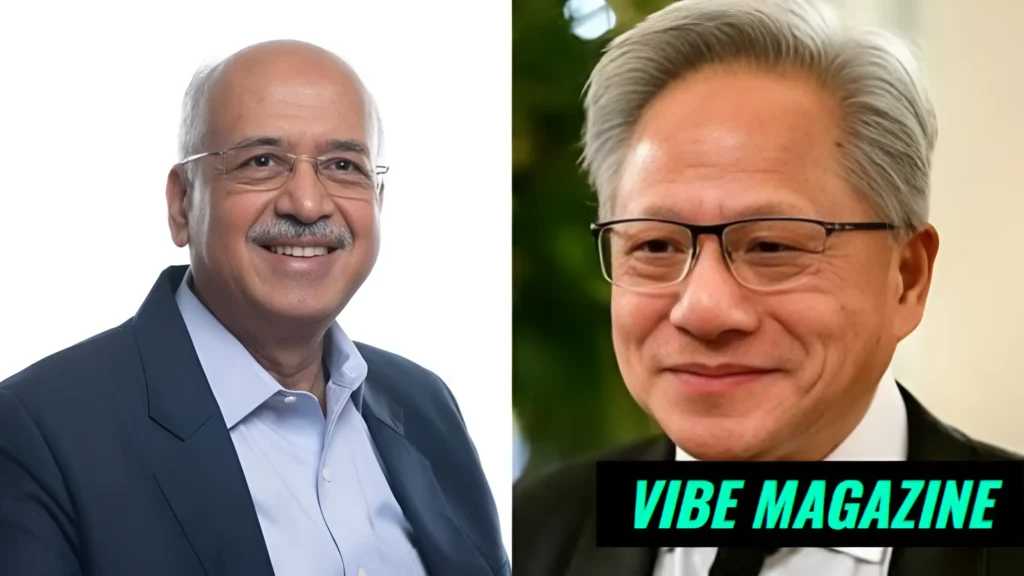
Dilip Shanghvi and Jensen Huang built their reputations in industries that appear to have little in common. One became closely associated with pharmaceuticals and healthcare, while the other helped build one of the world’s most important semiconductor companies. Yet their careers provide an interesting comparison because both founders spent decades developing businesses that eventually reached far beyond their original beginnings.
Shanghvi is the founder of Sun Pharmaceutical Industries, a company that grew from a relatively small pharmaceutical operation into an international healthcare business. Huang, meanwhile, co-founded NVIDIA in 1993 and remained at the center of the company’s development as it moved from computer graphics into accelerated computing, data centers, and artificial intelligence.
There is no established basis for treating Dilip Shanghvi and Jensen Huang as business partners, relatives, or collaborators. Their names are better understood together as part of a comparison between two entrepreneurs who built large companies in completely different fields.
Their stories are especially interesting because neither career can be reduced to one breakthrough. Shanghvi’s journey involved pharmaceutical products, international expansion, acquisitions, and long-term business development. Huang’s involved graphics processors, computing architecture, software ecosystems, and the transformation of GPU technology into a much broader computing platform.
Looking at both journeys side by side shows how different forms of expertise can become the foundation of a global business.
Dilip Shanghvi and Jensen Huang at a Glance
| Fact | Dilip Shanghvi | Jensen Huang |
|---|---|---|
| Full Name | Dilip Shantilal Shanghvi | Jensen Huang |
| Date of Birth | October 1, 1955 | February 17, 1963 |
| Place of Birth | Amreli, Gujarat, India | Tainan, Taiwan |
| Nationality | Indian | American |
| Profession | Entrepreneur and pharmaceutical business leader | Entrepreneur, engineer, and technology executive |
| Known For | Founding Sun Pharmaceutical Industries | Co-founding NVIDIA |
| Company | Sun Pharmaceutical Industries | NVIDIA |
| Industry | Pharmaceuticals and healthcare | Semiconductors and computing |
| Education | University of Calcutta | Oregon State University and Stanford University |
| Spouse | Vibha Shanghvi | Lori Huang |
| Children | Two | Two |
| Notable Recognition | Padma Shri and several business awards | Numerous technology and business leadership honors |
The Early Experiences That Shaped Their Careers
Dilip Shanghvi did not begin his career by building a multinational pharmaceutical corporation. His early exposure to the industry came through his father’s pharmaceutical distribution business.
That experience gave him an opportunity to see the medicine business from a commercial perspective. Instead of remaining solely involved in distribution, he eventually decided to move toward manufacturing.
In 1983, Shanghvi founded Sun Pharmaceutical Industries. The company started with a narrow focus and a small operation compared with the organization it would eventually become.
The early strategy was not based on trying to compete everywhere at once. Sun Pharma initially concentrated on a limited selection of medicines and gradually expanded its operations.
That gradual approach became an important part of the company’s story.
Shanghvi’s career also demonstrates how an entrepreneur can enter an established industry without necessarily having a conventional scientific background. His education was in commerce rather than medicine or pharmaceutical research. His contribution was primarily associated with business strategy, investment, expansion, and company building.
Jensen Huang entered his industry from a different direction.
He studied electrical engineering and developed professional experience in the semiconductor sector before establishing NVIDIA. His technical background was closely connected to the industry that would later become the foundation of his company.
Before NVIDIA, Huang worked at companies including LSI Logic and Advanced Micro Devices. Those experiences exposed him to semiconductor engineering and the challenges involved in developing computing technology.
In 1993, Huang co-founded NVIDIA.
At that point, NVIDIA was not the massive technology company associated with artificial intelligence and advanced computing today. Its early ambitions were centered on computer graphics and the emerging market for high-performance visual computing.
The difference between the two founders’ beginnings is revealing.
Shanghvi entered entrepreneurship after gaining commercial exposure to pharmaceuticals. Huang entered entrepreneurship after developing experience in semiconductor engineering.
Both started with a relatively focused opportunity and eventually expanded into much larger markets.
How Sun Pharma Became Shanghvi’s Central Business Story
The development of Sun Pharmaceutical Industries is inseparable from Shanghvi’s career.
The company began in 1983 and gradually expanded its products, markets, and capabilities. Instead of remaining a small domestic pharmaceutical operation, Sun Pharma increasingly pursued international opportunities.
Part of that expansion came through acquisitions.
For a pharmaceutical company, acquisitions can provide access to established products, manufacturing capabilities, distribution networks, research expertise, and new geographical markets. However, acquisitions also create challenges because the acquiring company has to integrate businesses with different systems and operations.
Sun Pharma’s acquisition of Ranbaxy became one of the most important transactions in its history.
The deal significantly increased the scale of Sun Pharma and strengthened its international presence. It also created the kind of integration challenges that accompany major corporate acquisitions.
This is an important part of understanding Shanghvi’s business career.
His story was not simply about inventing a product. It was about building an organization capable of competing at a much larger scale.
Over time, Sun Pharma expanded its activities across generic medicines, specialty pharmaceuticals, research, and international markets.
That evolution changed the nature of Shanghvi’s responsibilities as well.
Managing a small pharmaceutical company requires a very different approach from overseeing an international organization with manufacturing operations, research programs, regulatory obligations, employees across multiple markets, and a broad product portfolio.
Jensen Huang’s NVIDIA Started With a Different Opportunity
NVIDIA’s early story was connected to the rise of computer graphics.
During the 1990s, the personal computer industry was changing quickly. Video games were becoming more sophisticated, and consumers were increasingly interested in better graphics performance.
NVIDIA focused on graphics processors designed to handle increasingly demanding visual workloads.
The company’s development of GPU technology became a major turning point.
A graphics processor could perform certain types of calculations in ways that made it useful beyond traditional graphics. Over time, researchers and engineers recognized that GPU architecture could also be used for highly parallel computing tasks.
That opened a much larger opportunity.
NVIDIA’s technology gradually became relevant to scientific computing, data processing, machine learning, and eventually artificial intelligence.
This transition was not an overnight event.
It involved years of engineering investment and the development of software tools that allowed developers to use NVIDIA hardware for more than rendering graphics.
The company’s CUDA platform became particularly important because it helped developers write software designed to take advantage of NVIDIA GPUs for general-purpose computing.
This helped transform NVIDIA from a graphics hardware company into something closer to a computing platform company.
That distinction is important when considering Jensen Huang’s leadership.
The company’s success did not come solely from selling increasingly powerful chips. It also involved creating an ecosystem around those chips.
From Medicines to Computing: Why Their Companies Grew Differently
Sun Pharma and NVIDIA operate in industries with very different economics.
Pharmaceutical companies deal with drug development, manufacturing, regulatory requirements, intellectual property, distribution, and healthcare markets.
Semiconductor companies deal with chip architecture, engineering, manufacturing relationships, software, computing demand, and rapid technological change.
These differences influence the decisions their leaders have to make.
A pharmaceutical company can spend years developing a medicine and navigating regulatory requirements before the product becomes commercially important.
A semiconductor company can also spend years developing a new architecture, but once technology reaches the market, competition and product cycles can move extremely quickly.
For Shanghvi, company building involved developing a broad pharmaceutical portfolio and expanding geographically.
For Huang, it involved maintaining technological leadership while finding new applications for NVIDIA’s computing architecture.
Neither strategy can simply be copied into the other industry.
Shanghvi’s Expansion Was About Scale and Reach
One of the defining characteristics of Shanghvi’s career has been expansion.
Sun Pharma moved beyond its initial focus and developed an international presence through organic growth and acquisitions.
The company’s expansion demonstrates how an entrepreneur can use a relatively focused starting point as the foundation for a much broader business.
Acquisitions became particularly important.
Buying another company can accelerate growth, but it also brings additional responsibilities. Products have to be managed, employees integrated, manufacturing operations evaluated, and business cultures aligned.
For a pharmaceutical company, regulatory considerations make these challenges even more significant.
Shanghvi’s career therefore involves an important lesson about scale.
Growing a company is not simply about increasing sales. At a certain point, the entrepreneur has to build systems capable of supporting a much larger organization.
Huang’s Expansion Was Driven by New Uses for Technology
Jensen Huang’s journey shows another form of expansion.
NVIDIA’s original focus on graphics gradually developed into a much broader computing strategy.
The same basic technology that helped computers process sophisticated graphics could be used for other computational workloads.
This became increasingly important as machine learning developed.
Artificial intelligence systems require substantial computing resources, especially when training and operating large models. GPUs proved highly useful for these workloads because of their ability to perform many calculations simultaneously.
NVIDIA therefore found itself positioned in an expanding market that went well beyond traditional computer graphics.
This helped change the company’s identity.
Gaming remained important, but NVIDIA also became deeply associated with data centers, AI infrastructure, high-performance computing, robotics, and other areas where accelerated computing can be useful.
The transformation demonstrates how technological companies can grow when an existing product becomes useful for an entirely different class of problems.
Leadership Looks Different at Sun Pharma and NVIDIA
Comparing Dilip Shanghvi and Jensen Huang does not mean assuming they have identical leadership styles.
Their businesses require different forms of management.
Shanghvi’s leadership has been closely associated with strategic expansion, pharmaceutical business development, acquisitions, and long-term growth.
His role has involved understanding markets, evaluating businesses, and deciding where Sun Pharma should invest its resources.
Huang’s role has been more closely connected to technological direction.
NVIDIA operates in a field where product architecture, engineering talent, software development, and research can determine the company’s competitive position.
The CEO therefore has to understand not only the commercial side of the business but also the direction in which computing technology is moving.
Both roles require long-term thinking, but the substance of that thinking is different.
Why NVIDIA’s Software Ecosystem Matters
One of the most important developments in NVIDIA’s history was the realization that hardware alone would not be enough to establish a broad computing platform.
A powerful processor becomes significantly more useful when developers have tools that allow them to take advantage of it.
NVIDIA invested heavily in software and developer technologies that supported GPU computing.
This created an ecosystem around the company’s hardware.
That ecosystem became increasingly relevant as artificial intelligence and machine learning grew.
Researchers and companies could use NVIDIA hardware together with software frameworks and development tools to build increasingly complex applications.
The resulting business model was more extensive than simply manufacturing graphics cards.
It involved hardware, software, networking, systems, development platforms, and relationships with major technology companies.
This is one reason Huang’s career is closely associated with the broader transformation of NVIDIA.
Why Sun Pharma’s Portfolio Matters
Sun Pharma’s business model presents a different kind of complexity.
Pharmaceutical companies can have extensive portfolios covering different therapeutic areas and geographic markets.
A broad portfolio can reduce dependence on a single medicine or market, although each product still brings its own regulatory, commercial, and operational considerations.
Sun Pharma’s expansion into specialty medicines and research also shows how a company can move beyond a straightforward generic-drug model.
This is important because the pharmaceutical industry contains multiple layers.
There are established generic medicines, specialty products, innovative therapies, manufacturing operations, research programs, and distribution networks.
Managing these areas requires different capabilities.
Shanghvi’s long association with Sun Pharma therefore reflects more than the creation of one pharmaceutical company. It reflects the development of an increasingly complex healthcare business.
The Difference Between Founder Wealth and Company Value
Discussions about Dilip Shanghvi and Jensen Huang often include their estimated wealth.
Those figures can attract attention, but they require context.
A founder’s estimated net worth is not the same thing as the value of the company they founded.
For example, a founder can own shares in a public company. If that company’s share price rises, the estimated value of those shares increases.
That does not necessarily mean the founder received that amount as cash.
The same principle applies to Jensen Huang.
A significant portion of his wealth is connected to his ownership interest in NVIDIA. Changes in NVIDIA’s stock price can therefore have a substantial impact on his estimated wealth.
The distinction matters because billionaire rankings can change quickly.
An estimate from one month can be substantially different from an estimate several months later without the individual selling a large amount of stock.
For that reason, wealth figures should be treated as estimates rather than permanent facts.
Their Companies Also Reflect Different Forms of Innovation
Innovation does not look the same in every industry.
At Sun Pharma, innovation can involve new medicines, drug delivery systems, formulation improvements, manufacturing capabilities, and research into new treatments.
At NVIDIA, innovation involves computing architecture, semiconductor design, software, networking, and systems for accelerated computing.
Both require investment and specialized teams.
Neither business can depend indefinitely on the products that made it successful in its early years.
That is perhaps one of the clearest similarities between the two stories.
Companies have to evolve.
What Their Careers Suggest About Long-Term Entrepreneurship
The careers of Dilip Shanghvi and Jensen Huang offer several practical observations about building a company over decades.
Start With a Specific Opportunity
Neither entrepreneur began by trying to dominate an enormous global market.
Shanghvi started Sun Pharma with a focused pharmaceutical business.
Huang and his co-founders entered the graphics technology market.
A focused starting point can give a new company a clearer problem to solve.
Expand When the Market Creates a Reason
Sun Pharma expanded through additional products, markets, and acquisitions.
NVIDIA expanded from graphics into broader accelerated computing.
In both cases, expansion followed opportunities connected to the company’s existing capabilities.
This is different from simply entering unrelated markets for the sake of growth.
Build Capabilities Alongside Revenue
A growing company needs more than sales.
It needs people, systems, technology, research, management, infrastructure, and organizational processes.
Sun Pharma’s international expansion required pharmaceutical capabilities at a much larger scale.
NVIDIA’s expansion required a growing engineering and software ecosystem.
The organization has to grow alongside the opportunity.
Think Beyond the Original Business Model
Perhaps the most interesting lesson is that neither company remained exactly what it was at the beginning.
Sun Pharma developed into a diversified international pharmaceutical company.
NVIDIA developed from a graphics-focused business into a major accelerated-computing company.
Long-term entrepreneurship therefore involves recognizing when an existing capability can solve a larger problem.
Challenges Are Part of the Story Too
Large companies often look straightforward when viewed from the outside.
Their founders become famous, their businesses become globally recognized, and their financial figures receive significant attention.
The actual process is more complicated.
Sun Pharma has operated in an industry affected by regulation, competition, manufacturing requirements, pricing pressure, research risks, and acquisition integration.
NVIDIA operates in an industry affected by technological competition, supply chains, product cycles, enormous research requirements, and rapidly changing customer demand.
Neither founder operates in an environment where success is guaranteed.
This is why a useful comparison should not focus only on achievements.
Understanding the challenges surrounding their industries provides a more realistic picture of what managing these companies involves.
Are Dilip Shanghvi and Jensen Huang Connected?
The answer requires some care.
Their names may appear together in business comparisons, but that does not establish a direct personal or professional relationship.
Dilip Shanghvi is primarily associated with Sun Pharmaceutical Industries.
Jensen Huang is primarily associated with NVIDIA.
Their businesses operate in separate industries, and there is no established basis for describing them as partners in a shared company.
The meaningful connection is therefore their status as entrepreneurs who built influential businesses over several decades.
That distinction prevents an important mistake: assuming that two people are connected simply because their names appear together in an online search.
Frequently Asked Questions
Who is Dilip Shanghvi?
Dilip Shanghvi is an Indian entrepreneur best known as the founder of Sun Pharmaceutical Industries. He established the company in 1983 and played a central role in its development into an international pharmaceutical business.
Who is Jensen Huang?
Jensen Huang is a Taiwanese-born American entrepreneur and engineer who co-founded NVIDIA in 1993. He has served as NVIDIA’s president and CEO since the company’s founding.
What companies did Dilip Shanghvi and Jensen Huang build?
Dilip Shanghvi founded Sun Pharmaceutical Industries, while Jensen Huang co-founded NVIDIA.
Sun Pharma operates primarily in pharmaceuticals and healthcare, whereas NVIDIA operates in semiconductors, accelerated computing, and related technologies.
Are Dilip Shanghvi and Jensen Huang business partners?
There is no established public evidence that they are business partners or that they founded a company together.
Their names are more appropriately compared because both are long-serving founders associated with major companies.
What is the biggest difference between their businesses?
Sun Pharma operates in healthcare and pharmaceuticals, where medicines, manufacturing, research, and regulation are central.
NVIDIA operates in computing and semiconductors, where chip architecture, software, accelerated computing, and technology development are central.
How did Jensen Huang help NVIDIA expand beyond gaming?
NVIDIA developed GPU technology that became useful for workloads beyond computer graphics. Its hardware and software ecosystem eventually became important for scientific computing, machine learning, data centers, and artificial intelligence.
How did Dilip Shanghvi expand Sun Pharma?
Sun Pharma expanded through product development, international growth, research, and acquisitions. The acquisition of Ranbaxy was particularly significant in increasing the company’s scale and global reach.
Are their net worth figures fixed?
No. Estimated net worth can change as publicly traded company shares rise or fall and as other financial information changes. A billionaire’s estimated net worth should therefore be treated as a point-in-time estimate.
What can entrepreneurs learn from their careers?
Their careers show the importance of starting with a focused opportunity, developing strong organizational capabilities, adapting to changing markets, and expanding when new opportunities fit the company’s existing strengths.
Two Founders, Two Definitions of Scale
Dilip Shanghvi and Jensen Huang followed very different routes into entrepreneurship.
Shanghvi built his career around pharmaceuticals and gradually expanded Sun Pharma from its early operations into an international healthcare company. His story demonstrates how strategic expansion, acquisitions, product development, and long-term management can transform a focused business.
Huang’s career followed the development of computing technology. NVIDIA began with a focus on graphics and eventually became deeply involved in accelerated computing and artificial intelligence infrastructure. His story demonstrates how a technology can become far more valuable when its applications expand beyond its original market.
Neither journey is simply a story about money.
The more interesting part is how two entrepreneurs remained associated with their companies while those companies changed dramatically over time.
One built scale through healthcare and pharmaceuticals. The other helped build scale through computing technology.
Their industries may be different, their products may be different, and their paths may have little direct connection, but both careers illustrate the same broader reality of entrepreneurship: a company can begin with a narrow idea and eventually become something much larger when its capabilities, market opportunities, and leadership evolve together.
For More Visits: Vibemagazine


