


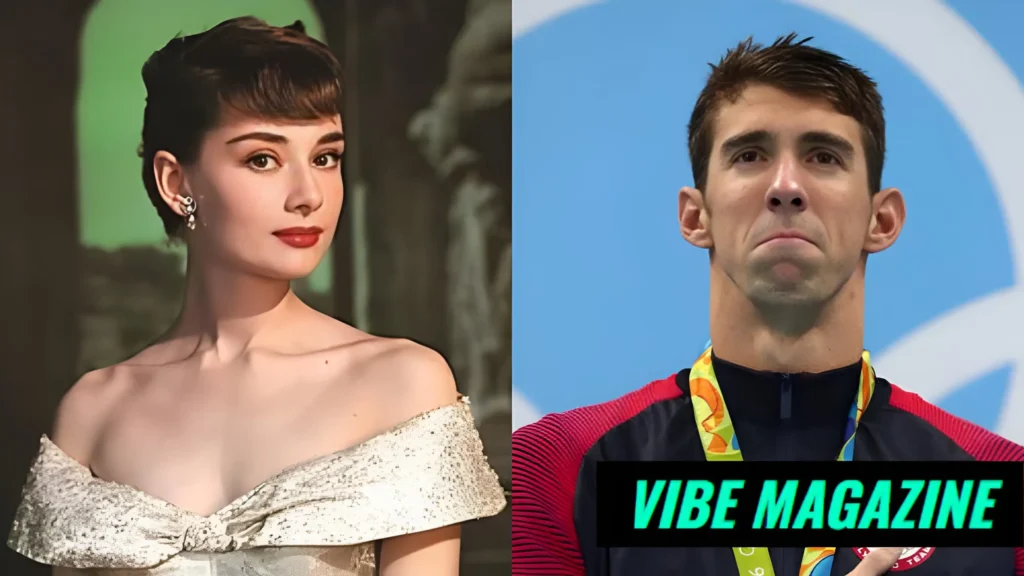
When people search for Audrey Hepburn and Michael Phelps, they are bringing together two names that appear to belong to completely different worlds. Hepburn became one of the defining figures of classic cinema, fashion, and humanitarian work, while Phelps built his reputation in a swimming pool, eventually becoming the most decorated Olympian in history. One was associated with film premieres, elegant costumes, and unforgettable characters; the other with starting blocks, world records, and Olympic gold medals.
There is no well-established personal or professional partnership between Audrey Hepburn and Michael Phelps. Their connection is instead a fascinating one created by the scale of their individual achievements and the way both became recognizable far beyond their original professions. Hepburn transformed herself from a young European performer into an international screen icon before devoting much of her later life to humanitarian work. Phelps emerged as a teenage swimming prodigy and spent more than a decade redefining what audiences believed one athlete could accomplish.
Looking at them side by side is useful precisely because their stories are so different. Their careers developed in different centuries, under different forms of public attention, and within industries that measure success in entirely different ways. Yet both demonstrate how exceptional talent can become something larger than a career. Their names eventually came to represent particular ideas: Hepburn became associated with elegance, individuality, compassion, and cinematic history, while Phelps became associated with discipline, athletic excellence, endurance, and the relentless pursuit of performance.
| Fact | Details |
|---|---|
| Full Name | Audrey Kathleen Hepburn; Michael Fred Phelps II |
| Date of Birth | May 4, 1929; June 30, 1985 |
| Place of Birth | Ixelles, Brussels, Belgium; Baltimore, Maryland, USA |
| Nationality | British; American |
| Profession | Actress, model, humanitarian; Former competitive swimmer |
| Famous Role / Known For | Roman Holiday, Breakfast at Tiffany’s, My Fair Lady, humanitarian work with UNICEF; 28 Olympic medals and 23 Olympic gold medals |
| Years Active | 1948–1989; 2000–2016 as an elite Olympic swimmer |
| Net Worth | No reliably established public figure; estate information is private; Phelps’ exact current net worth is also not publicly established |
| Marital Status | Deceased; married twice during her lifetime; married |
| Spouse | Mel Ferrer and Andrea Dotti; Nicole Johnson |
| Children | Sean Hepburn Ferrer and Luca Dotti; four sons |
| Notable Works / Achievements | Academy Award for Roman Holiday, Tony Award, Emmy and Grammy recognition, UNICEF humanitarian work; 28 Olympic medals, including 23 gold |
Two Lives That Took Very Different Paths
Audrey Hepburn was born in 1929 in Belgium and spent part of her childhood in the Netherlands. Her formative years were shaped by the instability of Europe before and during the Second World War. She initially dreamed of becoming a ballet dancer, and dance training became an important part of her early development. That background later proved useful when she moved toward stage performance and screen acting.
Michael Phelps, born in Baltimore in 1985, entered a completely different environment. His defining talent emerged in swimming, a sport that rewarded technical precision as much as physical ability. He began competing seriously while still young and eventually trained under coach Bob Bowman, whose influence became central to his development as an elite athlete.
The contrast is striking. Hepburn’s early ambition involved performance through movement, expression, and storytelling. Phelps’s depended on measurable performance: seconds, distances, strokes, medals, and records. One career was judged partly through artistic interpretation, while the other was constantly reduced to numbers on a scoreboard.
That difference makes their eventual fame particularly interesting. Hepburn could become memorable because of the character she played and the atmosphere she created on screen. Phelps became memorable because audiences could watch him repeatedly push the limits of measurable human performance.
Audrey Hepburn Before Hollywood Fame
Hepburn’s early life does not resemble the glamorous image that later surrounded her. Her childhood in wartime Europe exposed her to hunger, uncertainty, and the disruption of ordinary life. She continued studying ballet and developed an interest in performance, eventually moving toward theater and film.
Her first professional experiences were modest compared with the enormous fame that followed. She worked in stage productions and appeared in smaller film roles before gaining a major opportunity in the Broadway production of Gigi. That performance helped establish her as a promising young actress and opened the way toward Hollywood.
Her breakthrough came with Roman Holiday in 1953. Playing Princess Ann opposite Gregory Peck, Hepburn brought a combination of vulnerability, humor, sophistication, and freshness to the character. The performance turned her into an international star and earned her the Academy Award for Best Actress.
The significance of Roman Holiday extended beyond one successful film. Hepburn’s screen presence was unusual for the period. She did not fit neatly into the conventional image of a Hollywood leading woman. Her slender frame, expressive eyes, understated manner, and distinctive style made her immediately recognizable.
She subsequently appeared in films including Sabrina, Funny Face, The Nun’s Story, Breakfast at Tiffany’s, Charade, and My Fair Lady. Her career was not simply a sequence of popular films. It was also a gradual transformation of Hepburn into a cultural symbol.
Her achievements crossed several major entertainment fields. She won an Academy Award, a Tony Award, and later received Emmy and Grammy recognition, making her one of the rare performers whose career reached across film, theater, television, and recorded storytelling.
Why Audrey Hepburn Became More Than an Actress
The image of Hepburn is often reduced to fashion photography, elegant dresses, and her role as Holly Golightly in Breakfast at Tiffany’s. That description misses an important part of her legacy.
Hepburn understood the power of visual identity, but her public significance eventually moved beyond appearance. Her work with UNICEF became one of the defining chapters of her later life. She traveled to countries affected by poverty and humanitarian crises and used her fame to draw attention to the needs of children.
That transition matters when comparing her with Phelps. Neither person’s legacy can be explained entirely through their primary profession.
For Hepburn, humanitarian work changed the way the public remembered her. The actress who had once represented Hollywood glamour increasingly became associated with compassion and international advocacy.
Her humanitarian work also reflected something personal. Hepburn had experienced deprivation as a child during wartime, so the suffering of children was not an abstract concept to her. It gave another dimension to the public figure audiences had known through cinema.
Readers interested in classic celebrities, entertainment history, and the cultural lives of famous personalities can also explore the broader collection of stories featured by Vibe Magazine’s celebrity and culture coverage.
Michael Phelps and the Making of a Champion
Michael Phelps entered competitive swimming at a young age, and his development was unusually rapid. His physical abilities were important, but elite swimming also required an extraordinary willingness to repeat the same movements and training routines over long periods.
Under Bob Bowman, Phelps developed into an athlete capable of competing across several swimming disciplines. His Olympic career began at the 2000 Sydney Games when he was only 15 years old. He did not win a medal there, but the appearance marked the beginning of an Olympic career that would eventually become historic.
At Athens in 2004, Phelps won six gold medals and two bronze medals. Four years later in Beijing, he produced perhaps the most famous single Olympic performance of his career by winning eight gold medals.
That achievement surpassed Mark Spitz’s previous record of seven gold medals at one Olympic Games. Phelps was no longer simply a promising swimmer. He had become a global sporting figure.
His success continued at London in 2012, where he added six more medals, and then at Rio de Janeiro in 2016, where he won another six. Across four Olympic Games, he accumulated 28 medals, including 23 gold. Those numbers established him as the most decorated Olympian in history.
The scale of that achievement is difficult to compare with conventional sporting careers. Phelps was not simply dominant in one event. He competed across butterfly, individual medley, freestyle, and relay events, requiring different combinations of speed, endurance, technique, and tactical judgment.
His ability to maintain excellence across multiple Olympic cycles is arguably one of the most impressive parts of his career.
The Meaning Behind Phelps’s Olympic Numbers
Numbers are central to Phelps’s story in a way they were never central to Hepburn’s.
A film performance cannot be reduced to a single objective measurement. Critics can disagree about acting, audiences can interpret characters differently, and a movie’s cultural importance may grow decades after release. Swimming is different. A race ends with times and finishing positions.
Phelps therefore built a legacy that is unusually easy to quantify.
Twenty-three Olympic gold medals is a simple statistic. So is 28 total Olympic medals. But behind those numbers were years of preparation, travel, competition, recovery, disappointment, and repetition.
The Olympic World Library’s record of Phelps’s career highlights his extraordinary performances at Athens and Beijing, including the eight gold medals he won at the 2008 Games.
Yet the numbers alone do not fully explain why Phelps remained such an important public figure after retirement.
Part of his later influence came from his willingness to discuss experiences away from the pool. His public conversations about mental health helped broaden the discussion around the psychological pressures experienced by elite athletes. The Olympic movement has subsequently used Phelps’s story in educational material concerning athlete mental health.
That development creates one of the more meaningful comparisons with Hepburn.
Audrey Hepburn and Michael Phelps: Fame With a Second Chapter
At first glance, Hepburn and Phelps seem almost impossible to compare. One belonged to classic cinema; the other to modern international sport. One became famous for fictional characters; the other became famous for athletic performances.
But their public lives eventually moved beyond the activities that first made them famous.
Hepburn used her later years to advocate for children through UNICEF. Phelps established the Michael Phelps Foundation after the 2008 Olympics, with programs focused on swimming and healthier lifestyles. His foundation used his influence to encourage children to become active and develop positive habits.
The similarity should not be exaggerated. Their causes, organizations, and approaches were different. Hepburn worked as an international humanitarian advocate, while Phelps’s charitable work grew naturally from his identity as a swimmer and athlete.
Still, the pattern is worth noticing.
Both discovered that celebrity could function as a platform rather than simply a reward. Their professional accomplishments gave them public attention, and they later used that attention in areas beyond entertainment or competition.
This is perhaps the strongest legitimate connection between Audrey Hepburn and Michael Phelps.
Two Different Definitions of Discipline
Discipline is another point where their careers can be compared without pretending they followed the same path.
Hepburn’s discipline was artistic. Acting required memorization, rehearsal, emotional control, physical awareness, timing, and the ability to remain convincing in front of cameras and audiences. Her ballet training added another layer of physical discipline.
Phelps’s discipline was more visibly repetitive. Elite swimming involves countless hours in the water, strength training, technical work, conditioning, recovery, and race preparation. The athlete must perform movements repeatedly while maintaining concentration and physical precision.
The public usually sees the final performance. It sees the movie premiere or the Olympic final. What remains hidden is the routine required to reach that moment.
That is a useful way to understand both careers.
Hepburn’s elegance was not simply effortless charm. Phelps’s extraordinary Olympic performances were not simply natural athletic ability. Both depended on preparation that audiences rarely witnessed directly.
Public Image: Hepburn’s Elegance and Phelps’s Intensity
Few entertainers developed a visual identity as strong as Audrey Hepburn’s.
Her association with designers, particularly Hubert de Givenchy, helped create an enduring fashion legacy. Her clothing in films became part of the visual language of classic Hollywood, while her personal style continued to influence fashion long after her death.
But Hepburn’s appeal was not based only on clothing. Her acting style contributed to the image. She could appear sophisticated without seeming distant and playful without losing elegance.
Phelps developed almost the opposite public image.
His identity was built around physical intensity. His broad shoulders, long reach, distinctive swimming technique, and competitive focus became instantly recognizable to sports audiences. During the height of his career, his appearance at an Olympic pool often carried the expectation that another record or gold medal might follow.
The difference reveals how celebrity works differently across professions.
Hepburn’s image could remain powerful through still photographs, films, clothing, and interviews. Phelps’s image was closely connected to motion. His reputation was created through races that lasted minutes or even seconds.
The Role of Their Eras
The era in which each person became famous is essential to understanding their public identities.
Hepburn reached international stardom during the golden age of Hollywood. Movies were among the most powerful forms of mass entertainment, and a small group of actors could become global icons through theatrical releases, studio publicity, magazines, and television exposure.
Phelps became famous in an era of 24-hour sports coverage, internet publishing, social media, digital advertising, and constant public commentary. His performances could be watched around the world almost immediately.
That difference created different kinds of pressure.
Hepburn faced the expectations of Hollywood studios, photographers, critics, and fashion culture. Phelps faced not only traditional sports media but also the constant attention that surrounds contemporary athletes.
In that sense, they represent two different models of global celebrity.
Hepburn’s fame expanded through cinema and fashion until she became a timeless cultural figure. Phelps’s fame expanded through repeated athletic performances until his name became almost synonymous with Olympic swimming.
Personal Lives Away From the Spotlight
Both figures also had personal lives that attracted public interest, although neither can be reduced to relationships or family history.
Hepburn was married twice. Her first marriage was to actor Mel Ferrer, with whom she had her first child, Sean Hepburn Ferrer. Her second marriage was to Italian psychiatrist Andrea Dotti, with whom she had her second son, Luca Dotti.
She spent much of her later life in Switzerland and increasingly focused on family and humanitarian responsibilities rather than maintaining the relentless pace of Hollywood production.
Her decision to reduce her film work contributed to the unusual quality of her legacy. She did not remain constantly visible. Instead, her relative absence from the screen helped preserve the sense that each appearance mattered.
Phelps’s family life developed alongside a very different professional schedule. He married Nicole Johnson, and they have four sons. His family has been part of his life during and after his competitive career.
For Phelps, retirement did not mean disappearing from public life. He remained involved in swimming, charitable work, public speaking, and conversations about athlete wellbeing.
Is There a Direct Connection Between Audrey Hepburn and Michael Phelps?
This is the question that naturally appears when the two names are searched together.
There is no prominent documented collaboration, family relationship, shared professional project, or major historical event that directly connects Hepburn and Phelps. They were born more than five decades apart and became famous in entirely different fields.
Hepburn died in 1993, when Phelps was only eight years old. His international sporting career developed years later.
Therefore, it would be misleading to construct a fictional connection between them.
The more interesting answer is that the two names can be discussed together because they represent different versions of worldwide recognition. Hepburn became an enduring symbol of cinematic and fashion culture. Phelps became an enduring symbol of athletic excellence.
Both reached a level of recognition in which their names became shorthand for something larger than themselves.
When people hear “Audrey Hepburn,” they may think of classic Hollywood, Breakfast at Tiffany’s, Roman Holiday, fashion, elegance, or UNICEF. When people hear “Michael Phelps,” they may immediately think of Olympic swimming, gold medals, world records, and extraordinary athletic discipline.
That is a real connection, even if it is not a personal one.
What Their Careers Say About Legacy
Legacy is difficult to measure because it continues after a person’s active career ends.
Hepburn’s filmography remains widely recognized decades after her death. Her photographs continue to circulate, her films remain part of popular culture, and her humanitarian work has become an important component of how her life is remembered.
Her career also demonstrates that cultural influence can become independent of the original medium. Someone who has never watched Roman Holiday may still recognize Hepburn’s face, style, or name.
Phelps’s legacy works differently but reaches a similar level of recognition. His Olympic medal count provides an obvious foundation, but his influence also exists in the athletes who followed him and in the broader public understanding of what a swimmer could achieve.
His eight-gold-medal performance in Beijing became one of the defining Olympic stories of the modern era. His later openness about mental health added another dimension to his public identity.
The two legacies therefore share an important quality: they continued evolving after the most famous achievements had already happened.
Lesser-Discussed Similarities
One subtle similarity is that both became associated with expectations that could have become burdens.
Hepburn’s appearance was so closely associated with beauty and elegance that the public image sometimes overshadowed the complexity of the woman herself. Her career contained serious dramatic work that can be overlooked when her fashion legacy dominates the conversation.
Phelps experienced a comparable problem from the opposite direction. His extraordinary success created expectations that he would continue winning whenever he entered a pool. Once an athlete becomes synonymous with victory, anything short of victory can appear like failure.
Both therefore had to live with images larger than ordinary professional identities.
Another similarity is that neither career fits neatly into a single label.
Calling Hepburn simply an actress overlooks her theater work, fashion influence, and humanitarian role. Calling Phelps simply a swimmer overlooks his charitable activities, public advocacy, and post-retirement influence.
Their legacies became broader because their lives eventually moved beyond their original occupations.
Why People Still Search for Both Names
The continuing interest in Audrey Hepburn and Michael Phelps comes from different sources, but the underlying curiosity is similar.
People want to understand how exceptional public figures became exceptional.
With Hepburn, that curiosity often focuses on her transformation from a young woman shaped by wartime Europe into one of the most recognizable actresses of the twentieth century.
With Phelps, the question centers on how a young swimmer developed into an athlete capable of winning 23 Olympic gold medals.
Neither story is simply about fame.
Both involve development, discipline, pressure, reinvention, and the complicated relationship between a private individual and a public image.
That may explain why placing their names together creates an unexpectedly useful comparison.
Frequently Asked Questions About Audrey Hepburn and Michael Phelps
Were Audrey Hepburn and Michael Phelps related?
No known family relationship connects Audrey Hepburn and Michael Phelps. They came from different countries, different generations, and unrelated professional backgrounds.
Did Audrey Hepburn and Michael Phelps ever work together?
There is no established major professional collaboration between them. Hepburn’s career was centered on acting, theater, fashion, and humanitarian work, while Phelps became internationally known through competitive swimming.
What is the biggest achievement of Audrey Hepburn?
One of Hepburn’s most celebrated achievements was winning the Academy Award for Best Actress for Roman Holiday. She also became an important figure in theater, television, fashion, and humanitarian work.
What is Michael Phelps most famous for?
Michael Phelps is best known for his Olympic swimming career. He won 28 Olympic medals, including 23 gold medals, making him the most decorated Olympian in history.
How many children did Audrey Hepburn have?
Audrey Hepburn had two children: Sean Hepburn Ferrer and Luca Dotti.
How many children does Michael Phelps have?
Michael Phelps and his wife, Nicole Johnson, have four sons.
Did Audrey Hepburn do humanitarian work?
Yes. Hepburn became a UNICEF Goodwill Ambassador and traveled internationally to advocate for children affected by poverty, hunger, and humanitarian crises. Her humanitarian work became one of the defining parts of her later public life.
Did Michael Phelps do charitable work?
Yes. After the 2008 Olympics, Phelps established the Michael Phelps Foundation. Its work has included promoting swimming, physical activity, healthy lifestyles, and opportunities for young people.
Why are Audrey Hepburn and Michael Phelps sometimes discussed together?
There is no major direct relationship between them. They are more useful as a comparison between two kinds of global celebrity. Hepburn became a cultural icon through film, fashion, and humanitarian work, while Phelps achieved extraordinary international recognition through Olympic sport.
Where can readers learn more about Audrey Hepburn?
A useful starting point is the Audrey Hepburn biography on Wikipedia, which provides an overview of her life, career, films, awards, and humanitarian activities.
Conclusion: Two Icons, Two Kinds of Greatness
Audrey Hepburn and Michael Phelps did not share the same profession, generation, or path to fame. They did not build their reputations through the same kind of competition, and there is no major personal relationship linking their lives.
That is exactly what makes the comparison worthwhile.
Hepburn represents a form of cultural influence built through performance, personality, visual identity, and humanitarian commitment. Phelps represents a form of sporting greatness built through repetition, precision, competition, and an almost unprecedented level of Olympic achievement.
Their stories also show that public legacy rarely remains confined to the activity that first creates fame. Hepburn’s influence extended beyond acting into humanitarian work and fashion. Phelps’s influence moved beyond medals into charitable initiatives and conversations about athlete wellbeing.
Perhaps the strongest lesson in placing their names together is that greatness can take very different forms. One person can leave a mark through a character that audiences remember for generations; another can do it by repeatedly touching the wall first in the world’s biggest sporting arena.
Audrey Hepburn and Michael Phelps therefore belong to different chapters of cultural history, but they share something important: each turned individual talent into an identity recognized around the world. Their achievements were shaped by different circumstances, their careers demanded different forms of discipline, and their legacies continue for different reasons. Yet both demonstrate how a person’s influence can outgrow the profession that first made the world pay attention.
For More Visits: Vibemagazine


